
TruPunch 2000 vs. 3000 vs. 5000: Which TRUMPF Punching Machine Fits Your Shop?
TRUMPF's TruPunch line covers a wide range of production needs from economical entry-level punching to lights-out, high-volume series production. The three models available through Maintecx, the TruPunch 2000, TruPunch 3000, and TruPunch 5000, share the same foundational capabilities of punching, forming, tapping, marking, and deburring in a single setup, with all-tool rotation and access to TRUMPF's world's largest punching tool library. What separates them is drive architecture, throughput ceiling, part-quality features, and how far each can scale with automation.
This guide maps those differences to the volume, mix, surface-quality requirements, and automation ambition variables to determine which machine is the best fit for your shop.
What All Three TruPunch Models Have in Common
Every machine in the TruPunch line handles sheet thicknesses up to 0.25 in. (6.4 mm), supports all-tool rotation for complex forming operations, and integrates with TruTops Boost for nesting, path optimization, and digital workflow from design to finished part. All three can be paired with SheetMaster automation for loading and unloading and accept the full range of TRUMPF punching tools, including tapping tools, roller offsetting tools, cup tools, MultiTool adapters, and more.
The distinction between models mainly shows up in speed, drive technology, surface quality, tool capacity, and automation ceiling, all of which translate directly into production economics.
TruPunch 2000: The Economical, Flexible Starting Point
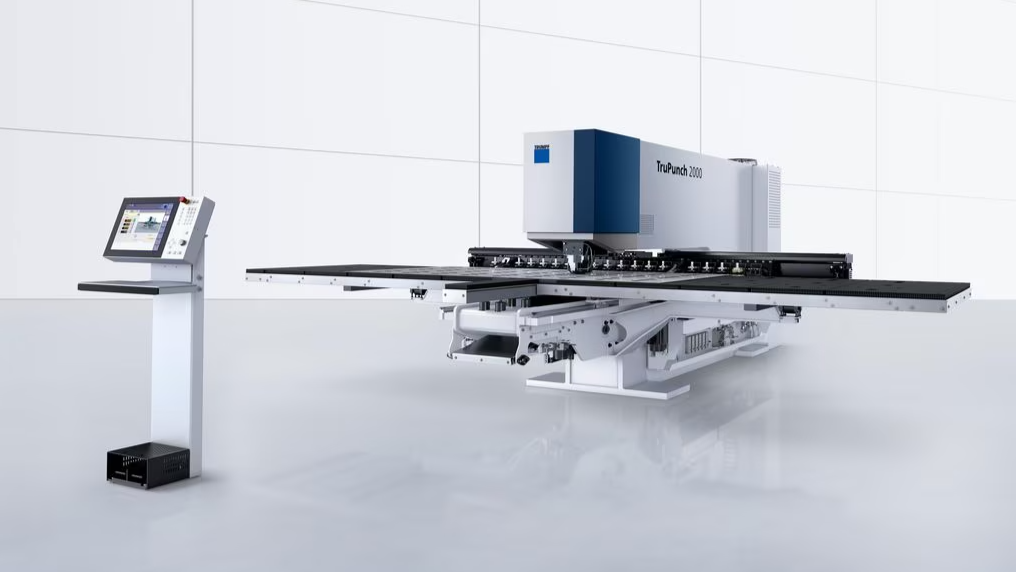
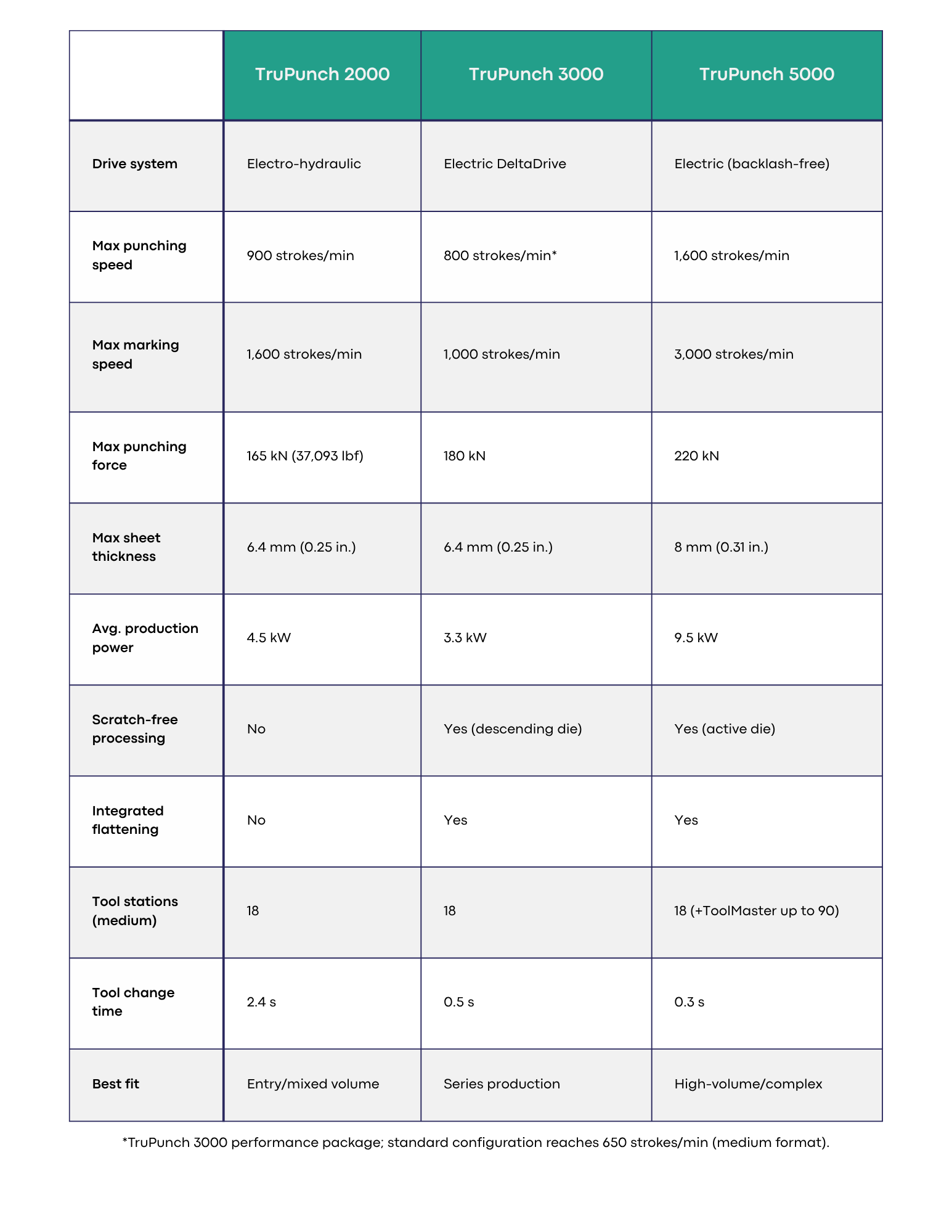
The TruPunch 2000 is the most compact and cost-efficient TRUMPF punching machine in the lineup. It runs on an electro-hydraulic drive and reaches punching speeds of up to 900 strokes per minute at a 1 mm stroke, with a maximum punching force of 165 kN and an average power input of 4.5 kW in production.
Its open C-frame design is one of the more underrated advantages. Loading and unloading large-format sheets is straightforward, and the machine handles a working range of 98.43 in. on the X-axis and 49.21 in. on the Y-axis. The linear magazine supports 18 tool stations, with a MultiTool changeover time of 2.4 seconds.
The TruPunch 2000 is the right fit when:
Your shop is adding punching for the first time and wants to enter automated punching economically
You need a reliable overflow machine to absorb peak loads without disrupting primary equipment
Your mix skews toward smaller to medium-format parts with complex forming requirements (electronics housings, medical components, and precision mechanical parts)
Floor space is a constraint; the compact footprint makes this machine manageable in tighter facilities
Automation is a future consideration rather than a current requirement
The TruPunch 2000's power consumption is lower than that of the 3000 and 5000, and its On-Demand Drive keeps the hydraulic system operating at optimum levels only when needed, reducing noise and system load during non-productive time. For shops with variable workloads or a heavy mix of short runs, this machine offers the best combination of flexibility and efficiency.
TruPunch 3000: High-Throughput Series Production with Scratch-Free Results
The TruPunch 3000 introduces a fundamentally different drive architecture called the DeltaDrive, a fully electric, patented system that eliminates Y-axis movement of the sheet and support table. Instead of moving the material, the punching head flies, moving back and forth in the Y direction while the sheet moves only in X. This design has two major benefits for production:

Throughput increases: The medium-format TruPunch 3000 with the performance package reaches 800 strokes per minute (punching, 1 mm stroke), and the DeltaDrive enables faster repositioning between hits than a conventional sheet-transport system. This architecture advantage compounds across shifts for dense part programs.
Surface quality improves: The descending die (a standard feature on the TruPunch 3000) lowers the die table during the punching stroke, which prevents the sheet from lifting and dragging across the table surface. When paired with brush tables for material support, the TruPunch 3000 produces consistently low-scratch results on surfaces that would otherwise show damage on a conventional punching machine. This is particularly useful for parts that go directly to a customer without additional finishing, like panels, enclosures, and visible components.
The TruPunch 3000 also includes an integrated flattening function that corrects surface irregularities created by forming stresses during the punching process itself. Parts come off the machine flat, without a separate leveling operation.
Additional specs for the medium-format configuration include a working range of 98.43 in. (X-axis), a maximum sheet thickness of 6.4 mm, a punching force of 180 kN, and an average production power input of just 3.3 kW, lower than the TruPunch 2000 despite higher throughput, thanks to the electric DeltaDrive replacing the hydraulic system.
The TruPunch 3000 also supports full lights-out operation. The SheetMaster Compact handles loading and unloading with a storage capacity of up to three tonnes, and the SortMaster Compact handles finished-part sorting using individually controllable suction cups suitable for small and complex parts without additional floor space requirements. Smart punch monitoring verifies that holes were actually punched before each tool change, catching broken punches before they cause a run of rejects.
The TruPunch 3000 is the right fit when:
You're running demanding series production, and throughput per shift is a primary constraint
Surface quality matters (parts go to customers without secondary finishing, or your material is already painted/coated)
You want the lowest possible operating costs from an electric drive system
Multi-shift or unattended operation is already part of your production model, or you're planning to move in that direction
Floor space is a consideration (the TruPunch 3000 requires up to 25% less installation area than comparable machines in its throughput class)
TruPunch 5000: Maximum Speed, Maximum Automation Ceiling
The TruPunch 5000 is TRUMPF's highest-performance punching machine. In medium format, it reaches 1,600 strokes per minute for punching at a 1 mm stroke and 3,000 strokes per minute for marking, both substantially higher than 3,000 strokes per minute. Maximum sheet thickness increases to 8 mm (vs. 6.4 mm on the 2000 and 3000), and maximum punching force rises to 220 kN. Average power input in production is 9.5 kW, reflecting the machine's higher output ceiling.

The TruPunch 5000 includes backlash-free drives, retractable clamps, and an active die to keep sheet surfaces low-scratch at speeds that would cause surface damage on a hydraulically driven machine. Integrated flattening is standard, and the sheet format recognition system automatically detects and adjusts to varying sheet sizes, reducing setup time and the risk of positioning errors across a mixed sheet load.
Tool handling is where the TruPunch 5000 most clearly separates itself from the 3000. The ToolMaster Linear accommodates up to 90 tools, with a MultiTool changeover time of 0.3 seconds, compared to 0.5 seconds on the TruPunch 3000 and 2.4 seconds on the TruPunch 2000. For programs with high tool variety and tight cycle-time requirements, those fractions of a second add up across thousands of strokes per shift. The TruPunch 5000 large format also supports 21 tools and 4 clamps in its standard magazine, with a working range of 120 in. (X-axis) and 61 in. (Y-axis).
The ECO function automatically shifts the machine into an energy-saving standby mode during production breaks, which partially offsets the higher production power draw of the machine compared to the TruPunch 3000.
The TruPunch 5000 is the right fit when:
Your shop runs high-volume, high-mix series production, and throughput is the primary bottleneck
Your part programs involve a wide variety of tools, and you need the fastest possible changeover between them
You're processing material thicker than 6.4 mm that exceeds the TruPunch 2000 and 3000's rated capacity
Your automation requirements include full lights-out production with integrated tool management (the TruPunch 5000 is designed to scale with the full TRUMPF automation ecosystem)
You're making a capital investment in a machine that serves as the centerpiece of a high-output punching cell
How to Use These Differences to Choose
Three questions drive the decision in most cases:
How many shifts are you running, and how much of that time is the machine actually cutting?
The TruPunch 2000 is efficient at variable workloads and short runs. The TruPunch 3000 and 5000 both reward high utilization. The faster cycle times and automation compatibility pay off when the machine runs continuously.
Does your part quality require scratch-free processing?
If customers see the surface, or if you're processing pre-treated or pre-painted material, the descending die on the TruPunch 3000 and the active die on the TruPunch 5000 give your production scratch-free advantages. The TruPunch 2000 does not include this feature.
How complex are your programs, and how often are you changing tools?
High tool variety and tight cycle-time requirements push toward the TruPunch 5000. The 0.3-second tool change time and 90-tool ToolMaster Linear capacity are specifically designed for dense, high-mix programs. The TruPunch 3000's 0.5-second changeover handles the most demanding series production. The TruPunch 2000's 2.4-second changeover reflects its position as a flexible, lower-volume platform.
Explore TRUMPF Punching Machines at Maintecx
We carry the full TruPunch line across our multi-state territory. If you're working through the decision for your shop, our applications engineers can walk you through your part mix, volume requirements, and floor plan before you commit to a configuration.
Explore our TRUMPF punching machines or contact us to start a conversation about which TruPunch model fits your production goals.
