
Robotics in Manufacturing: Where Robots Are Earning Their Keep
North American companies ordered 8,940 robots worth $622 million in the second quarter of 2026, a 21.3% jump in order value over the same quarter last year, according to the Association for Advancing Automation (A3) data. Metals sector orders climbed 18% year over year, and general industry buyers accounted for the majority of units ordered for the first time on record. Robotic automation in metal fabrication has moved past the pilot-project stage. It's a live purchasing decision on shop floors across our territory right now.
This article covers where robots are actually working in a fab shop today, including sorting laser-cut parts, welding, machine tending, and custom applications for specific processes. It also breaks down the three ways to bring a robot onto your floor, and how to decide which application to automate first when more than one bottleneck is competing for the budget.
Why Robots Are Showing Up In Fab Shops Now
Skilled labor is tight across manufacturing, and fabrication feels it as much as any sector.
Automotive plants automated welding and material handling decades ago. Fabrication lagged due to the high-mix, low-volume work that made programming a robot cost more than the labor it replaced. A shop running fifty different parts in a week couldn't justify writing a new program for each one.
However, collaborative robots now let an operator teach a weld path by hand-guiding the torch through it once without any programming language. AI-assisted vision reads a part's CAD data and calculates a robot's motion plan on its own. The programming burden that kept robots out of high-mix fabrication for two decades has largely disappeared, and that's why robotics is now showing up on job shop floors automotive-style automation never reached.
Four Places Robots Pay Off In A Fab Shop
1. Sorting Laser-Cut Parts
TRUMPF's 2D laser cutting machines got fast enough that the bottleneck moved. Now what happens after the cut slows things down? This might look like an operator pulling parts off the skeleton by hand and sorting them into bins while the laser sits idle waiting for room to unload the next sheet.
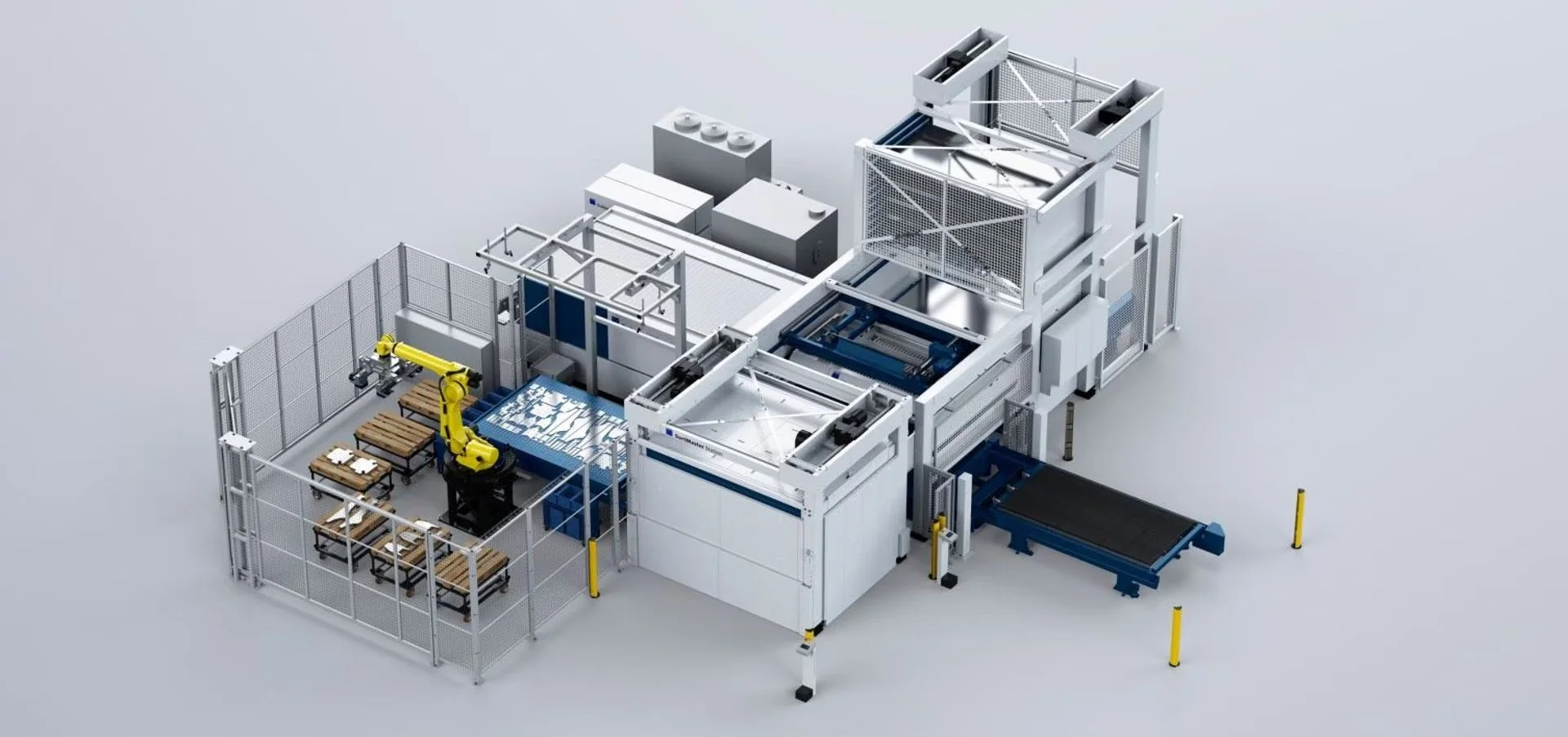
The new SortMaster Station handles the first half of that problem, separating finished parts from the scrap skeleton regardless of size or geometry, without an operator standing over it. Then the new SortMaster Vision picks and palletizes the parts using AI-assisted vision, which TRUMPF announced was developed together with Intrinsic. The system reads part information directly from the cutting program and simulates the removal in advance, so there's no sorting program to write for every new job. It handles parts up to an inch thick, including geometries that defeated older mechanical sorting systems.
SortMaster Station reaches US availability in September 2026, with SortMaster Vision following in 2027. If your laser already outpaces your ability to clear the table, it's worth planning for now, ahead of the hardware shipping.
2. Welding
The US welding workforce is aging out faster than it's being replaced. AWS workforce data puts the current workforce at 771,000 professionals, with over 157,000 nearing retirement and under 10% younger than 25. The AWS Foundation projects the country will need 320,500 new welders by 2029, and the South, Southeast, and Great Lakes regions, which cover most of our territory, hold roughly 60% of that workforce today. That's a Tuesday morning problem for a shop in Alabama or Wisconsin turning down weld work because nobody's available to run the torch.

TruArc Weld 1000 solves lot sizes of one, the part of welding traditional robots never addressed. An operator hand-guides the torch through the seam once to teach it, and a weld program is ready in under a minute. Smart Seam Tracking adjusts torch position live during the weld, correcting for part-to-part variation that fixed programs can't handle. The cell runs one or two stations through a raisable partition, so an operator can set up the next job while the robot finishes the current one. Fast teaching plus live tracking makes this pay off on small batches, not just the high-volume runs traditional robotic welding was built for.
3. Loading, Unloading, and Machine Tending
Machine tending is the broadest category, and it's usually where a shop starts. A single redeployable robot can move between several machines instead of being locked into one, which helps shops that don't run any single process at high enough volume to justify a dedicated cell.
AutoTend runs on a heavy-duty modular cart with precision leveling feet so that it can move between a press brake, FINISHLINE deburring machine, CNC, or inspection station. The UR20-based package handles payloads up to 20 kg (44 lbs), and integrated area scanners let it run on the open floor without a full safety cage. For bending specifically, BendMaster inside a TruBend Cell 5000 handles parts up to 220 lbs with gripper and vacuum technology, automatic gripper changes, and sheet sensors that identify parts as they load.
4. Custom Applications
Not every process matches something sold off the shelf. That's what Starmatik exists for. TRUMPF acquired a 25.1% stake in the Italian automation firm in August 2021, and the partnership gives Starmatik access to TRUMPF's global sales and service network. Founded in 1996 and based in Spresiano, Italy, the roughly 100-person firm builds robotic automation around bending, welding, grinding, laser loading and unloading, and sheet handling, engineered around a customer's specific process rather than adapted from a standard product.
This is the path for a shop whose bottleneck isn't served by a standard cell or a redeployable cobot. It costs more and takes longer to engineer, but it fits a real process instead of forcing that process to fit a machine. If your shop's constraint doesn't match anything covered so far, that's usually the sign this is the right conversation to have. Our smart factory services team maps these builds in stages, so you're not committing to the full system before the first piece proves out. Contact us to talk through what a custom cell would take.
Three Ways To Put A Robot On Your Floor
Every conversation about manufacturing robotics eventually ends up asking the same question: cobot, fixed cell, or custom engineered? Understanding all three determines cost, flexibility, and lead time.
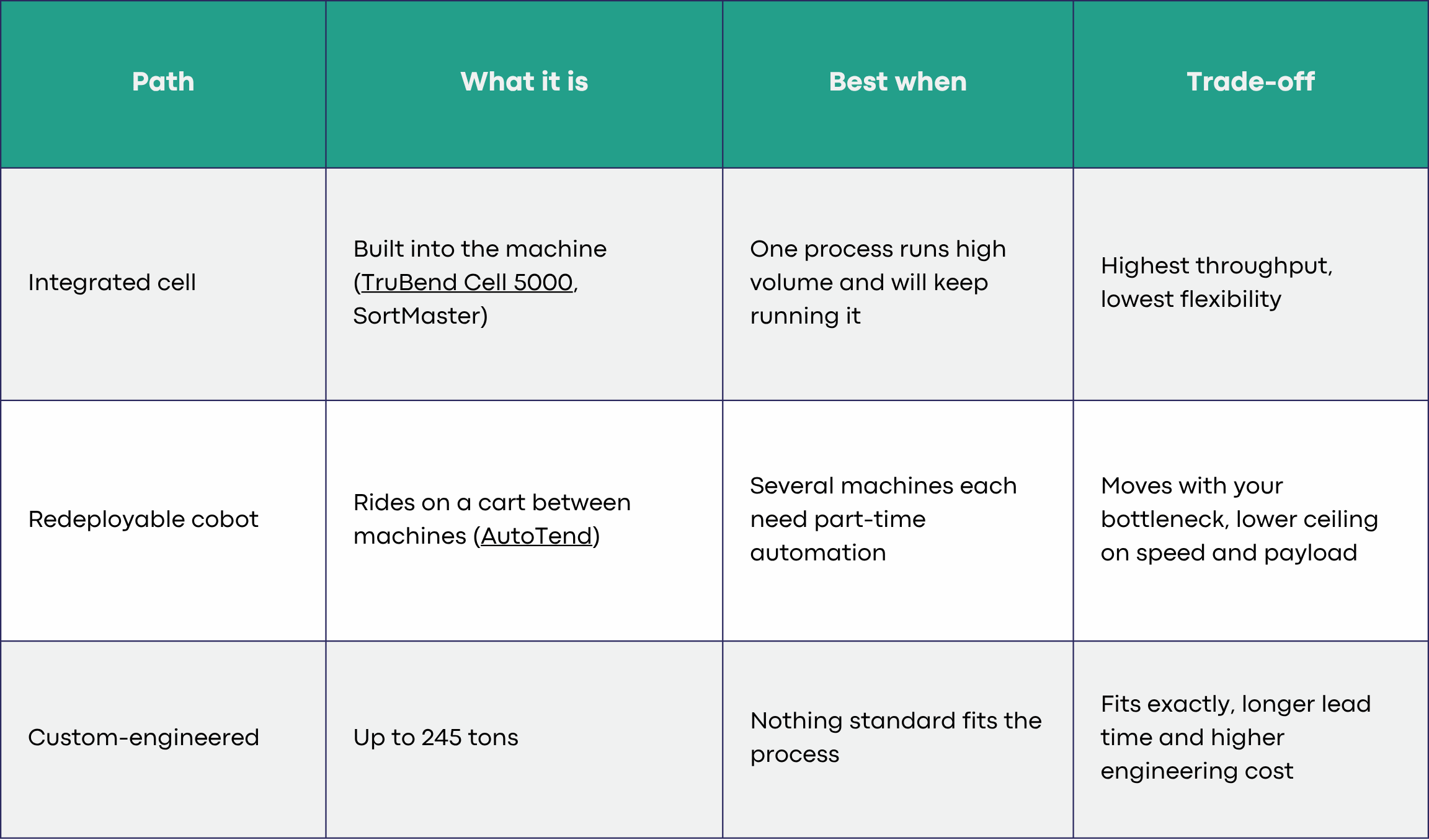
An integrated cell earns its keep on a process that runs the same way every day. A redeployable cobot earns its keep spread across several machines that each need automation part of the time. Custom engineering earns its keep when neither of those fits, because your process doesn't look like anyone else's. This is the question we get asked most often on a floor walk, and it rarely has one right answer. Most shops end up running some combination of all three as their automation program matures.
Which Application Should You Automate First?
The four applications above, and the three ways to buy in, only matter once you know where to point them. Most shops have more than one process that could use a robot. The question is which one to automate first.
Run through these statements in order and start with the first one that describes your shop:
Your laser finishes sheets faster than anyone can clear the table. Sort first.
Parts stack up in front of the press brake while an operator loads blanks one at a time. Tend first.
You're turning down weld work, paying weld overtime, or waiting on a hire that hasn't come through. Weld first.
The bottleneck is a process nobody sells a standard cell for. Go custom, and budget engineering time accordingly.
More than one of these describes your shop. Start with whichever one is idling your most expensive machine.
The decision on which robot to buy should really come from which asset is sitting underused. That's how our applications engineers approach a floor walk.
Ready To Find Your First Automation Win?
Robotics in manufacturing used to be a single purchase decision to buy a robot, bolt it to a machine, and be done. It's a sequence now, depending on your part mix, labor situation, and which machine on your floor is quietly holding everything else back.
Our applications engineers spend their days walking fabrication shop floors across our ten-state Midwest and South territory, identifying exactly where automation pays off first and where it can wait. Contact us to schedule a floor walk, and we'll help you figure out which of these four applications is worth automating first in your shop.
Frequently Asked Questions About Manufacturing Robotics
Do I Need A Robot Programmer On Staff?
Not for the systems covered here. Cobots like AutoTend and TruArc Weld 1000 are taught by hand-guiding the robot through the task once. SortMaster Vision calculates its own motion plan from the cutting program. None of these need a dedicated robotics programmer for day-to-day operation.
Can One Robot Work On More Than One Machine?
Yes, if it's a redeployable cobot. AutoTend rides on a modular cart and moves between a press brake, deburring machine, CNC, and other stations as your schedule requires. Integrated cells like SortMaster and TruBend Cell 5000 stay with the machine they're built into.
Is Robotic Welding Worth It For Small Batches?
It can be, with the right cell. Traditional robotic welding needed high volume to justify its programming cost. Some machines, like the TruArc Weld 1000, make it worth it with hand-guided teaching that produces a weld program in under a minute. This makes it viable at a lot size of one.
How Thick A Part Can A Sorting Robot Handle?
SortMaster handles parts up to one inch (25 mm) thick, including complex geometries that older mechanical sorting systems couldn't manage.
