
How AI Is Finally Making Flexible Parts Sorting a Reality
For years, automated parts sorting has worked great until it didn't. Feed a system simple, flat, medium-thickness parts in consistent batches, and it handles them fine. The moment you introduce a complex geometry, a thick profile, or a batch of one, you're back to a person standing at a table doing it by hand.
That has been the accepted reality for most shops. TRUMPF's new SortMaster Station and SortMaster Vision, now available through Maintecx, are the first solutions designed to completely close it. They make it possible to sort any laser-cut part, any geometry, any batch size, with zero programming required. It's a specific technical claim worth unpacking because the how is what makes this different from every other industrial parts-sorting approach that came before it.
Why Conventional Automated Parts Sorting Systems Hit a Wall
To understand why this matters, you need to understand why conventional automated parts sorting systems hit a wall with complex parts.
Traditional approaches, such as optical vision systems, vibratory sorters, and conveyor-based sortation, all share the assumption that the parts being sorted are sufficiently predictable to program around and that someone has to predefine what the system is looking for. Optical systems check for shank length, thread presence, and head diameter at high speed, but only because someone pre-defined what to look for. Vibratory and mechanical sorters use fixed rail gaps, so they work only with consistent fastener sizes. Conveyor sortation with shape recognition works inside a predefined range of shapes.
This creates problems for sheet metal fabricators:
Parts vary constantly across jobs and customers
Complex geometries fall outside pre-programmed shape libraries
Small parts tip and shift inside the scrap skeleton before the robot can grip them
Thick material (beyond roughly 12 mm) behaves differently from the light-gauge assumptions most systems are built around
Job shops running mixed production often change part numbers multiple times per shift
Programming a sorting robot for every new part geometry takes time and skilled labor. For shops running varied work or tight batch sizes, the programming overhead has made full automation impractical. The parts that cannot be removed using conventional solutions just stay manual. The SortMaster Station and SortMaster Vision were built specifically to solve this.
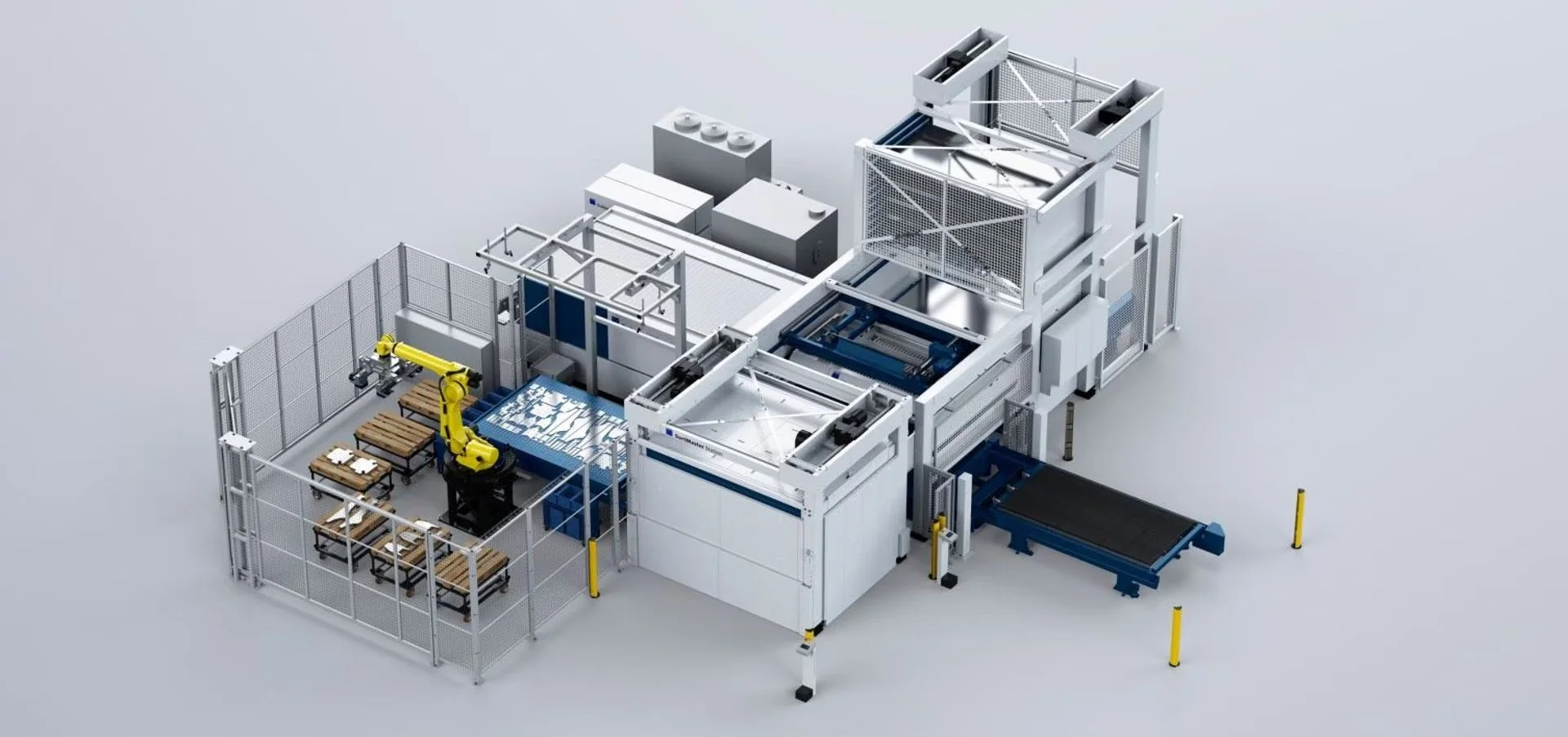
What "No Programming" Actually Means Day to Day
When TRUMPF says SortMaster Vision requires no programming, that's not shorthand for "easy programming." It means no programming at all. Zero.
Here's how that works operationally:
The cutting program already contains full geometric data for every part on the sheet.
SortMaster Vision automatically pulls that data directly from the cutting program.
Using the part geometry data, the AI software simulates multiple possible removal sequences and gripping approaches before the robot moves.
At runtime, it selects the best option based on actual part position and orientation.
The robot calculates its own motion plan, including gripping points, for every job, every time. For a shop running varied part types, this changes the daily reality at the sorting station. A new part number requires no setup on the sorting side. A batch of one custom part carries the same automation overhead as a batch of 500. Shops that previously had to carve out manual labor hours for their complex or low-volume work can now run those parts through the same automated workflow as everything else.
How AI-Driven Image Recognition Powers Independent Movement Planning
The technical foundation behind this capability comes from a multi-year collaboration between TRUMPF and Intrinsic, an AI and robotics software company in the Alphabet group. Together, they developed what TRUMPF calls adaptive robotics, or the automated perception combined with autonomous robot path planning.
After the SortMaster Station separates parts from the scrap skeleton, regardless of geometry or sheet thickness, the SortMaster Vision takes over. Here’s what it does:
Recognition: An AI-assisted camera scans the separated parts and compares them against the cutting order data already loaded into the system.
Planning: The software autonomously calculates a full motion plan including optimal gripping points for each part, accounting for orientation, neighboring parts, and tipping risk.
Execution: The robot picks, orients, and palletizes each part based on the motion plan it generated.
Continuous production: While Vision sorts the current sheet, the laser-cutting machine processes the next sheet.
This differs from traditional robotic bin picking, which also uses 3D vision-guided arms but still requires pre-programmed constraint sets. SortMaster Vision generates a fresh motion plan for each job from actual cutting program data rather than working within fixed programming boundaries.
This means the system can handle parts that conventional automated parts sorting systems cannot, like:
Complex geometries outside standard shape libraries
Small parts are prone to tipping in the skeleton
Parts cut from thick material up to 25 mm
Single-unit custom parts with no prior sorting history
The Full Workflow: SortMaster Inside the Maintecx Ecosystem
The SortMaster system doesn't operate in isolation. Inside a Maintecx-equipped facility, it fits into a connected workflow that addresses every manual handoff in the fabrication process.
The complete autonomous workflow:
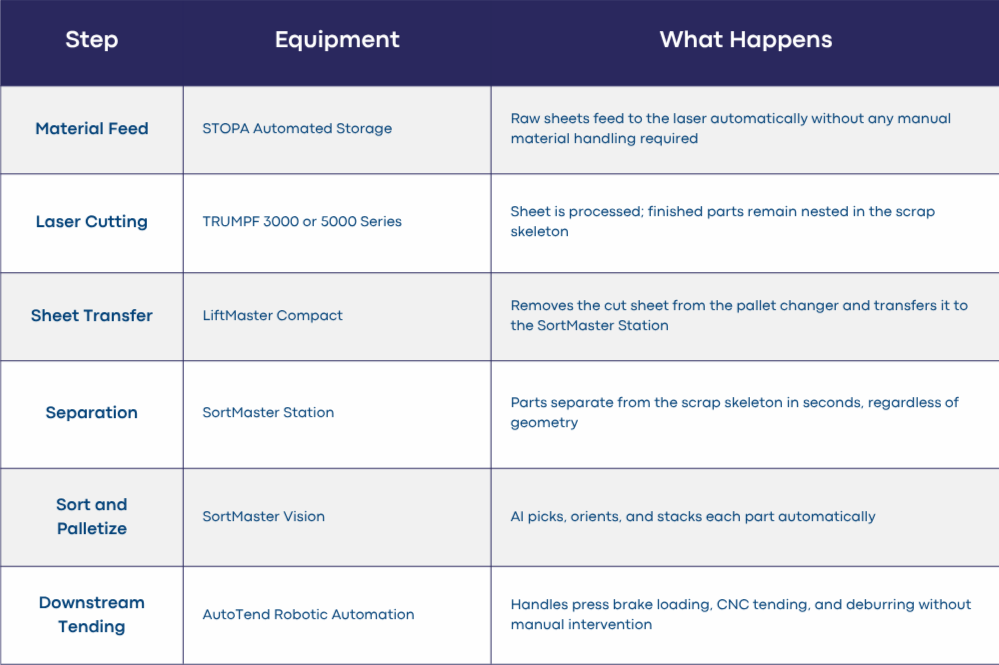
The only human task in this chain is removing the finished stacks of sorted parts. Each step connects to the next without a manual handoff. That matters for two reasons: labor hours and data. Every automated step also generates production data that feeds back into scheduling, utilization tracking, and job costing. Manual steps generate no data and add unpredictable time to the workflow.
What This Means for Shops Running Small Batches
Shops running high-volume, low-variation production have been able to justify sorting automation for years. The programming cost spread across thousands of identical parts makes financial sense. For job shops and fabricators running mixed production, short-run custom work, or rapid-turnaround orders, that math never worked.
The old equation:
A sorting robot requires a programming setup for each part number
The setup cost only makes sense if the batch is large enough to absorb it
Result: complex or low-volume parts stay manual
The new equation with SortMaster Vision:
No programming required for any part number
The setup cost is zero for every job, regardless of batch size
Result: a batch of one runs through the same fully automated workflow as a batch of 500
This opens automated parts sorting to a category of work that has always been off the table. With shops competing on speed, flexibility, and custom capability, you gain real operational advantages.
Availability and Compatibility
Both SortMaster products work with TRUMPF 3000 and 5000 series laser cutting machines and support retrofit installation, so existing equipment does not need to be replaced to add this capability.
Release timeline:
SortMaster Station: Available for purchase in the United States starting September 2026
SortMaster Vision: Available for purchase in 2027
The Bigger Picture: Sorting as the Last Manual Job
Sorting has long been called the last manual job in sheet metal fabrication. The reason was that the variability problem was hard to solve with conventional automation. You could automate almost every other step, but someone always had to finish the sort.
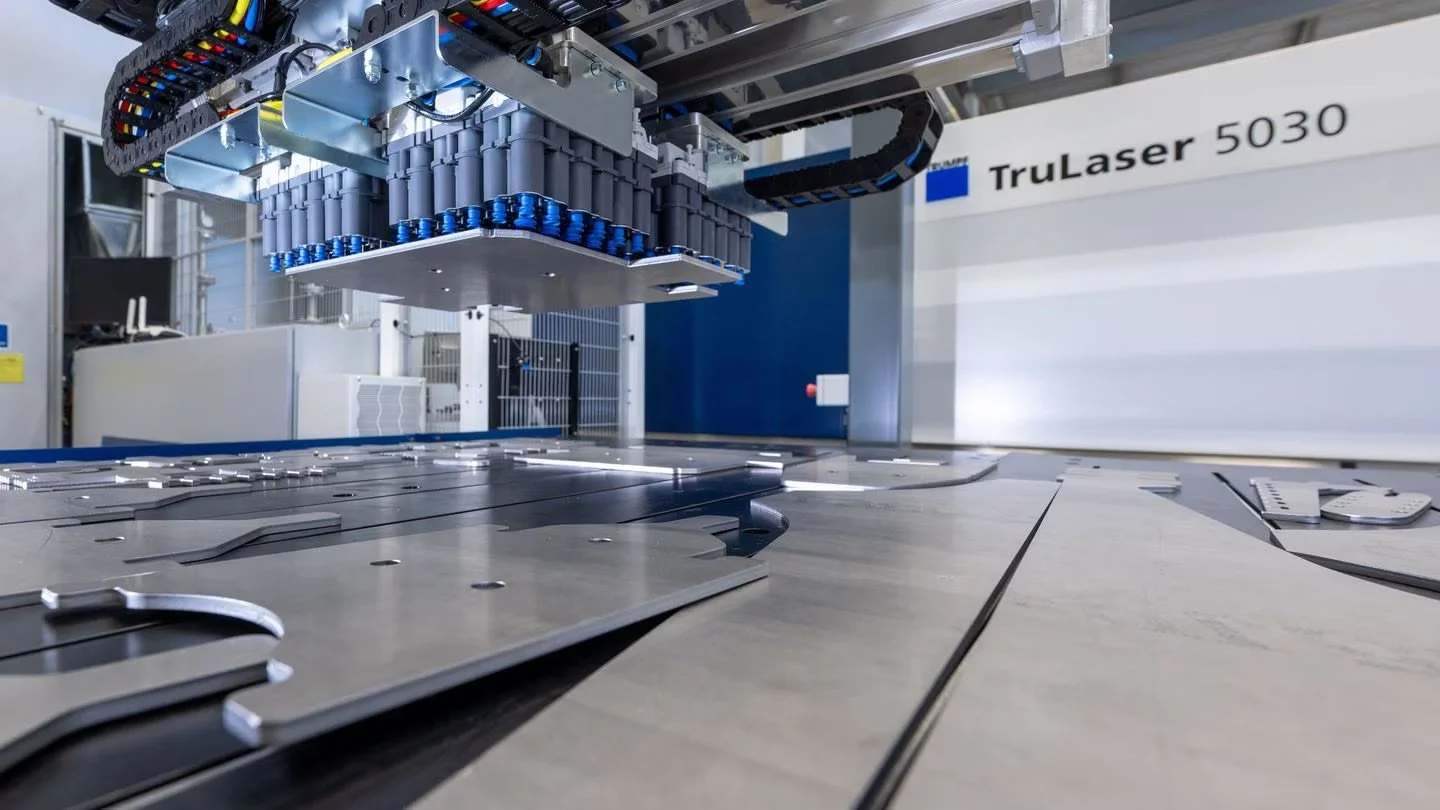
That assumption no longer holds. The implications go beyond a single workstation. Every manual step in a production workflow is also a scheduling constraint and a data gap. When sorting runs automatically, jobs flow through the process on a predictable timeline. Production data stays complete. Scheduling software can account for sorting time without built-in human variability.
For shops working toward a fully connected smart factory, automated sorting closes the last open gap in the post-cut workflow. The laser feeds from STOPA; the cut sheet moves to SortMaster; and the sorted parts move to AutoTend for downstream processing. Raw material in, finished sorted parts out.
Ready to Close the Gap in Your Workflow?
If your shop still has a manual sorting step, that is where the conversation starts. We work with fabricators across Wisconsin, Minnesota, the Dakotas, Nebraska, Western Iowa, Upper Michigan, Tennessee, Mississippi, and Alabama to build connected workflows around TRUMPF equipment.
Whether you are adding SortMaster to an existing TRUMPF line or planning a new automated cell from scratch, we can help you map the right configuration for your part mix and production volumes. Contact Maintecx to discuss automated sorting for your facility.
