
TruStore or STOPA? A Buyer's Guide to Sizing Storage to Your Shop's Growth
TruStore and STOPA both come up in the same conversation about manufacturing storage solutions, and shops often treat them like two options on the same list. We see them as two different tools for two different stages of growth. TruStore is a catalog product that gets bigger through defined modules. STOPA is a custom-built logistics center engineered around a specific building and material mix.
Getting this choice right depends on where a shop sits on its growth curve. The sections below cover what each system stores, the capacities Maintecx installs most often, the signals that tell you which tier fits, and what a layout visit covers before a recommendation is made.
TruStore and STOPA Solve Different Problems
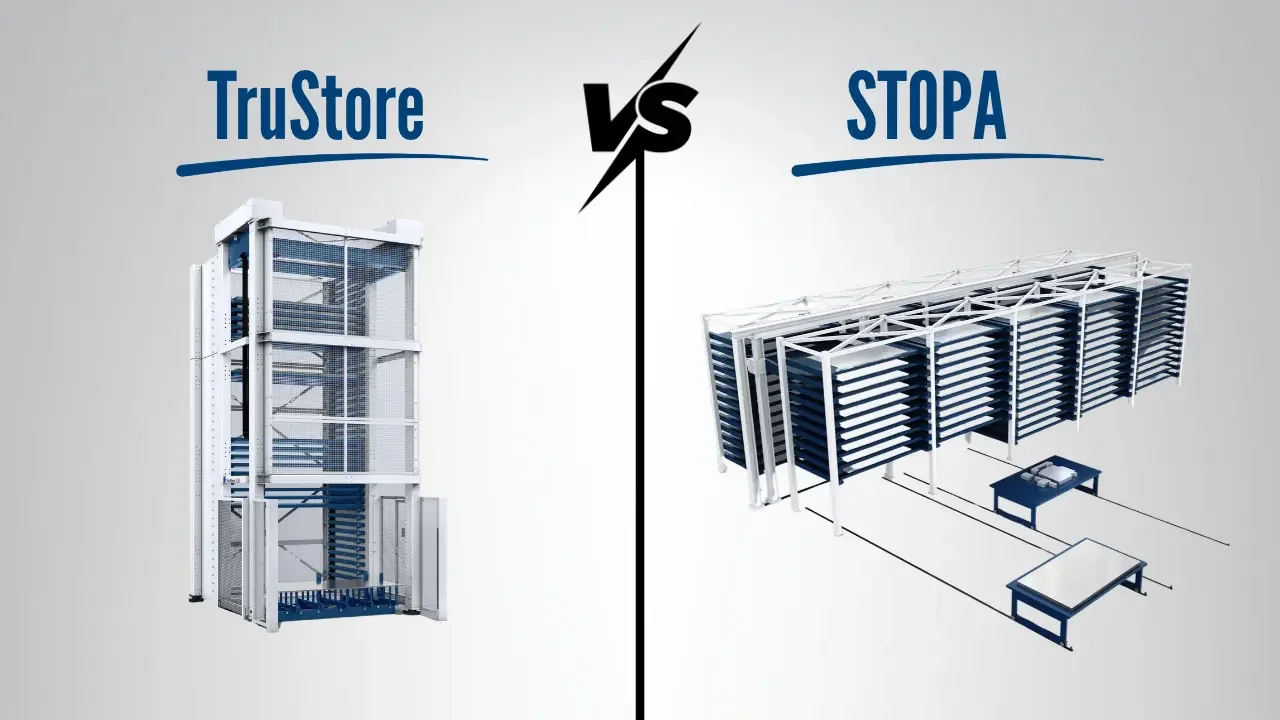
TruStore is a vertical tower. Sheet goes in on pallets, a crane or picker retrieves what a machine needs, and the tower plugs into one or two TRUMPF laser or punch machines. It’s a standardized product line. A shop buys a known configuration with published capacities.
STOPA is engineered to the dimensions of a specific building and material mix. Length, width, height, and sheet format all get built to spec. It functions as a logistics hub that feeds multiple machines, multiple bays, and downstream processes like automated bending, all coordinated through software.
That difference explains why the same production numbers can point two different shops toward two different systems, and it drives almost every sizing question that follows.
TruStore Tower Storage Grows With Your Machines
TruStore comes in a few different tiers.
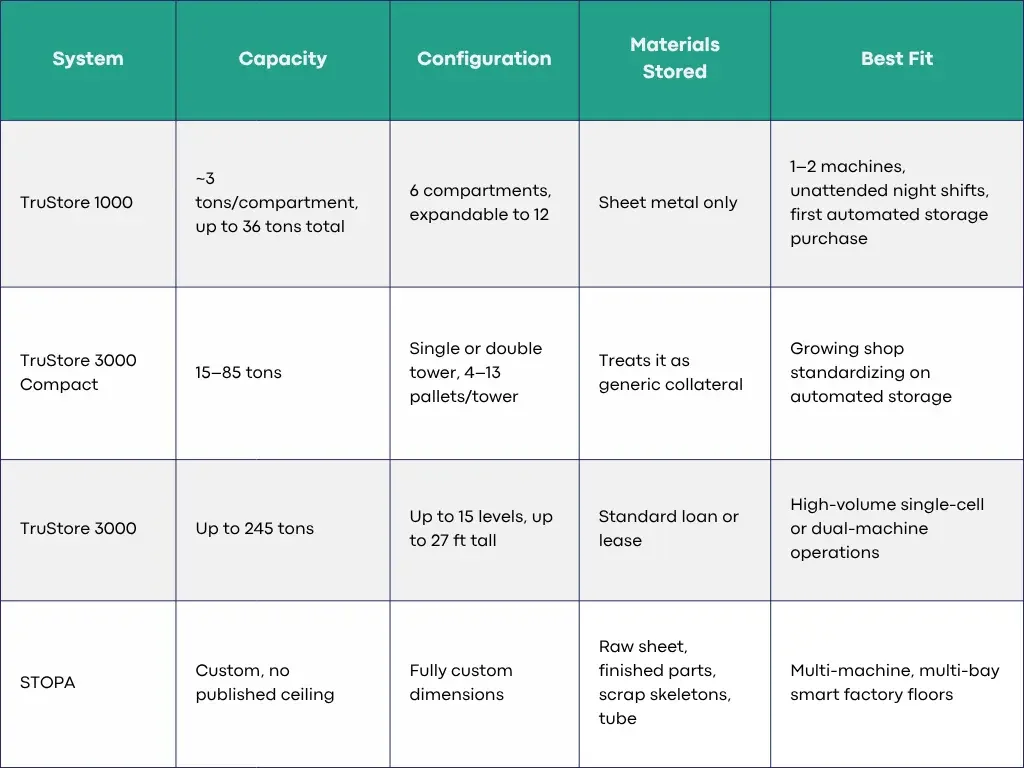
The TruStore Series 1000 is the entry point. It holds roughly 3 tons per compartment, ships standard with 6 compartments, and expands to 12. It connects to up to two LiftMaster Linear units feeding a TruLaser, and it's built for shops running unattended or lights-out shifts on one or two machines. It's also built to grow. TRUMPF designed it to upgrade into a Series 3000 by adding a pallet-picker crane, so a shop that starts small isn't locked into replacing the whole system later.
The Series 3000 Compact sits in the middle. It’s often called the perfect starting point in TRUMPF storage technology, and the capacity backs it up. It runs 15 to 85 tons in large format and up to 75 tons in maximum format, with single or double towers holding anywhere from 4 to 13 pallets depending on configuration.
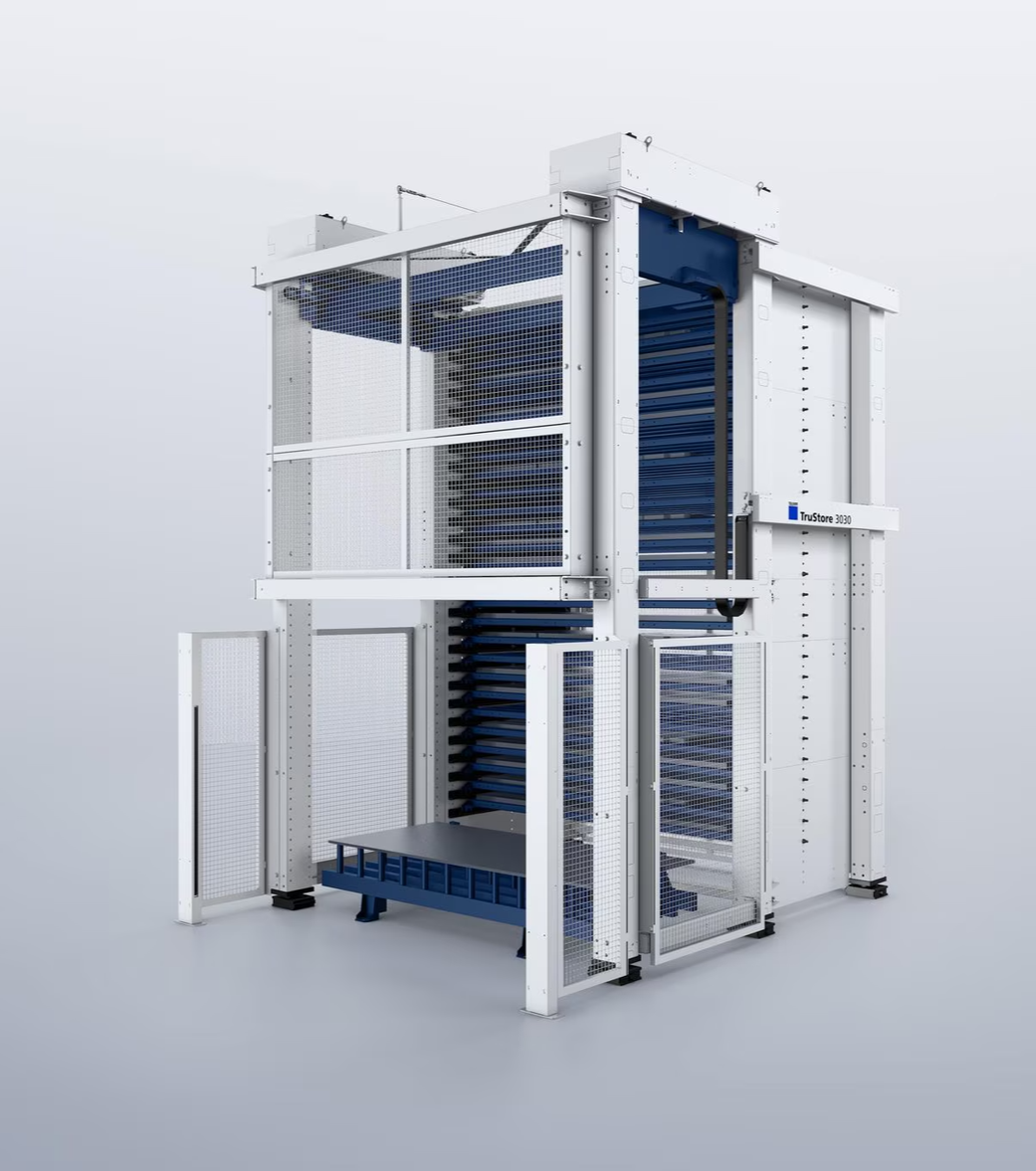
TruStore Series 3000
The full TruStore Series 3000 is where tower storage reaches its limit. It holds up to 245 tons of capacity, offers up to 15 configurable levels, and reaches system heights approaching 27 feet. TRUMPF's own figures put floor space reduction at up to 85% compared to conventional flat storage. At this tier, TruStore also connects to a broader automation stack that includes LiftMaster for loading and unloading, PartMaster for sorting finished parts, SortMaster for stacking, and ToolMaster for tool management.
TruStore stays built around standard pallet formats and a defined footprint at every tier. That works well for a long time. It stops working well once the material mix grows beyond sheet metal.
STOPA Large-Scale Storage Runs a Full Logistics Center
STOPA fits shops that have already outgrown a simple storage buffer. It stores raw sheet, finished parts, scrap skeletons, and tube profiles, all in the same system. Dimensions are fully custom. Length, width, height, and sheet format are engineered to the building and the workflow.

The automation runs 24/7 and supplies multiple machines continuously across the whole system. It uses roughly 25% less energy than conventional storage approaches, and the structure is steel-built to handle the load distribution of running at that scale. Software such as TruTops Boost coordinates operations by tracking inventory in real time and scheduling jobs across every bay the system feeds.
STOPA is also a bigger capital commitment than any TruStore tier, and pricing comes through a custom quote based on the specific build. That reflects the scope of the work. Every install gets engineered around a different building, a different material mix, and a different set of machines.
Capacity and Fit at a Glance
Matching the System to Your Shop's Growth Stage
Capacity numbers only mean something next to your own production data. A few signals tend to separate shops that belong in TruStore territory from those that have moved past it.
TruStore still fits well when most of the following describe your shop:
One or two machines pull from the same storage buffer
Sheet metal is the only material stored this way, while tube, scrap, and finished parts still get handled manually or off to the side
Floor space is a real constraint, but the goal is one cell running efficiently, not an entire building's material flow
The shop runs lights-out shifts on a single cell and needs reliability above all else
STOPA fits better when the shop looks more like the following:
Multiple machines across multiple bays need to pull from one coordinated system
Tube, scrap skeletons, and finished parts all need a home in the same logistics flow alongside raw sheet
Growth has already outpaced what a 245-ton tower can hold, or that point is visible within a couple of years
Downstream automation such as bending cells and multi-stage sorting needs to run on the same schedule as inventory
TruStore and STOPA aren't really steps on the same ladder. Moving from a Series 1000 to a Series 3000 is a defined upgrade path that TRUMPF built directly into the product line. Moving from any TruStore tier to STOPA works differently. A shop taking that step is starting a separate capital project sized for a different scale of operation, alongside whatever TruStore equipment already runs on the floor. Shops that assume they'll add a STOPA system later sometimes find it becomes its own ground-up build.
More capacity does not automatically make for a safer buy. A 245-ton TruStore 3000 sitting three-quarters empty for two years ties up capital that could go toward equipment the shop can use right now. It can also mean paying for automation depth, like PartMaster sorting or ToolMaster management, without the machine count to justify it yet. Sizing to where a shop will realistically be in two or three years beats sizing to a five-year hypothetical, especially since TruStore's tiered structure means a shop doesn't get penalized for scaling up later.
What a Maintecx Layout Visit Actually Sizes
Published specs and growth patterns narrow the decision, but floor plans, machine mix, and growth plans vary enough between shops that a spec comparison can only point in a general direction.
Maintecx's applications engineers run this assessment the same way they approach any equipment-sizing question. They review the current machine mix and how material moves between machines, check where automation would help and where it would slow things down, and map the shop's stated growth plans against what each storage tier can realistically support over the next several years. It's the same kind of layout thinking behind why ERP data alone doesn't fix a floor-flow problem. The software can show what's happening on the floor, but sizing storage correctly means starting with the physical layout.
That visit is where a shop finds out whether a TruStore 3000 Compact covers the next five years or whether the material mix already justifies a STOPA conversation. Guessing on either side of that line gets expensive. Under-buying means replacing a system sooner than planned. Over-buying means paying for a custom logistics center sized for a factory floor that doesn't exist yet.
Which One Fits Your Shop Today
If the honest answer is "we store sheet, we run one or two machines off it, and floor space is tight," TruStore almost certainly fits, and the only real question is which tier. If the answer involves tube, scrap, finished parts, and more than one bay pulling from the same system, start the conversation with STOPA, even if the final spec ends up smaller than expected.
Either way, the sizing math depends on data specific to one shop's floor, machines, and growth plans. Request a layout visit and get the actual numbers for your operation before committing to either system.
